Overview
Section 508
IBM NS1 Connect's DNS platform serves some of the largest companies in the world, answering over 4.5 trillion queries per month and enabling people and organizations globally to access information online.
But it couldn't serve the U.S. government. Federal procurement under Section 508 requires WCAG 2.1 AA compliance as a baseline — and our product didn't meet it. That single gap was locking NS1 out of a government cloud and SaaS market exceeding $10 billion annually. Non-conformant vendors don't get a second look. They get disqualified.
Those who made it happen
Terry Bernstein – Senior Director of Product Management
Ishita Parekh – Product Manager
Didier Blanchard – Engineering Manager
Jonathan Rice Madden – Product Program Manager
Da Liu – Front-End Lead
Shane Kerr – Back-End Lead / DNS SME
Tony Hartonias – Product Designer
Craig Lordan – Information Designer
The playing field
Not just accessibility
Beyond compliance, the portal had real usability problems. Rapid platform growth over the previous couple of years had introduced unclear interfaces, visual and behavioral inconsistencies, and confusing flows with no contextual guidance.
These weren't edge cases. They were friction points for every user, not just those relying on assistive technology. Making the portal accessible without addressing the underlying usability issues wasn't realistic. It's worth noting that we couldn't redesign the portal from scratch — the work had to layer onto existing patterns without breaking workflows that enterprise customers depended on daily.
We also needed to move fast while having had limited prior accessibility expertise, which meant we had to simultaneously delivering the work and building internal knowledge and adopt best practices.
MUI v5 -> Carbon v11
The NS1 Connect portal was built on MUI v5, with a component library that had grown organically without governance or regular maintenance. That lack of oversight was a root cause of the usability issues customers were experiencing — inconsistent patterns, accessibility gaps, and compounding design debt across the product.
There had been earlier efforts to improve the library's accessibility, but IBM's acquisition of NS1 shifted priorities and the work stalled. The component library was effectively neglected, and the problems kept accumulating.
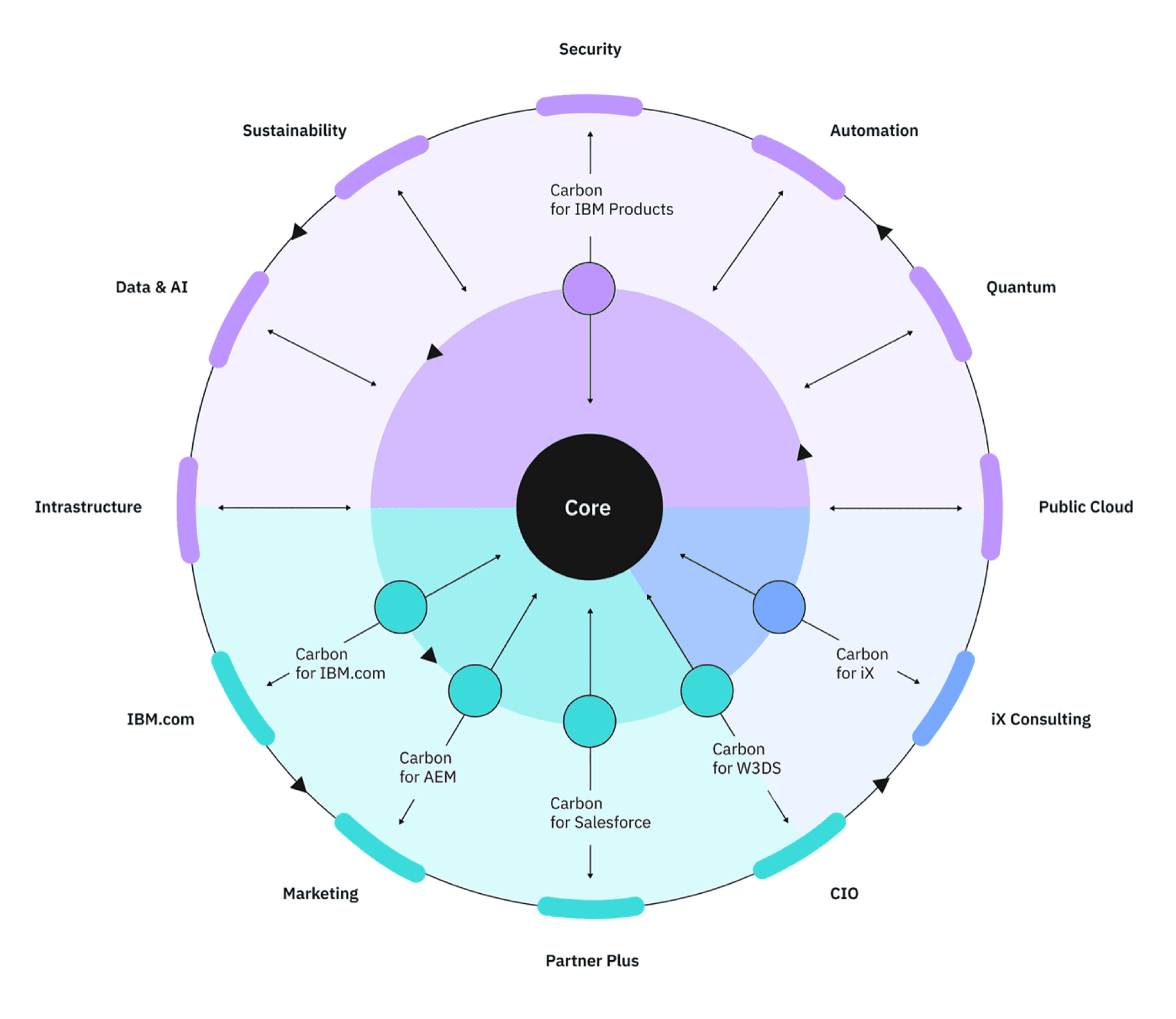
The acquisition also introduced a clear path forward: migration to IBM Carbon v11. IBM had spent years building one of the strongest design systems for enterprise software, with accessibility baked into its foundations. That made the migration more than a brand alignment exercise, it became the most efficient lever for bringing the portal up to conformance and resolving the systemic usability issues at their source.

My role and respobsibilities
The redesign followed a phased approach. The visual design team led the first two phases, migrating styling and typography tokens to IBM Carbon and aligning the portal's look and feel with IBM's brand. I was brought in to lead the third and most complex phase: redesigning the pages and user flows of the IBM NS1 Connect portal.
Beyond owning the screens and flows, my role sat at the intersection of design, product, and engineering. I drove prioritization decisions, aligned with product management on project direction, and held ongoing feasibility discussions with engineering to make sure what we designed could actually ship within our constraints. It was as much a coordination effort as a design effort.
The key moves
1. A comprehensive audit and prioritization exercise
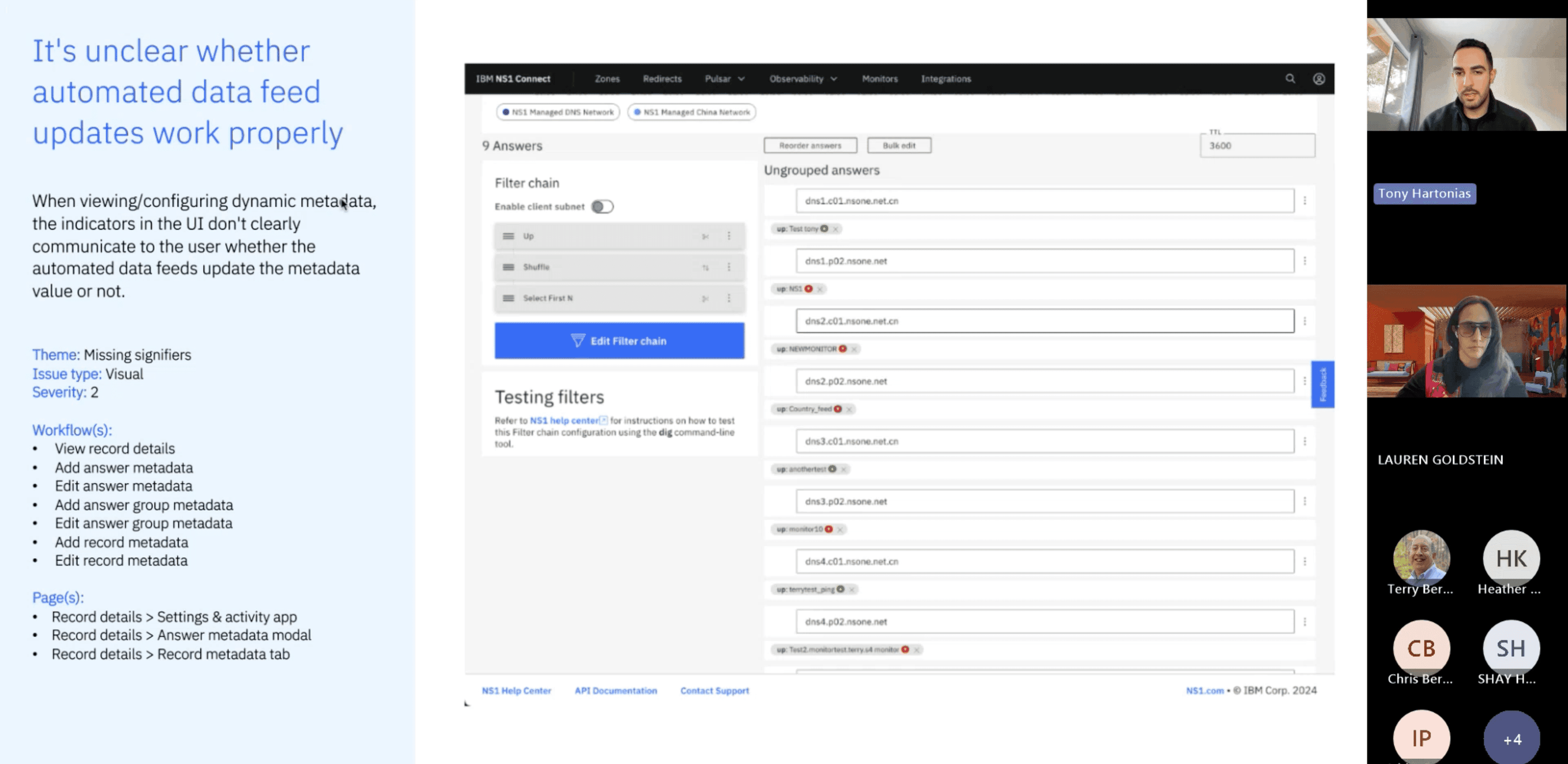
At the beginning of the project I ran a full usability and accessibility audit of the portal to get a clear sense of what we were up against. I didn't treat the audit as a pass/fail spreadsheet. I mapped every failure to a real user scenario — what breaks, how, and at what severity across four dimensions: usability, content, accessibility, and bugs.
This reframing changed the prioritization conversation entirely. Instead of fixing issues by severity level in the abstract, we tackled them by user impact and engineering effort, which let us close the highest-value gaps first while the longer-tail fixes moved in parallel.
2. Redesigning 200+ workflows
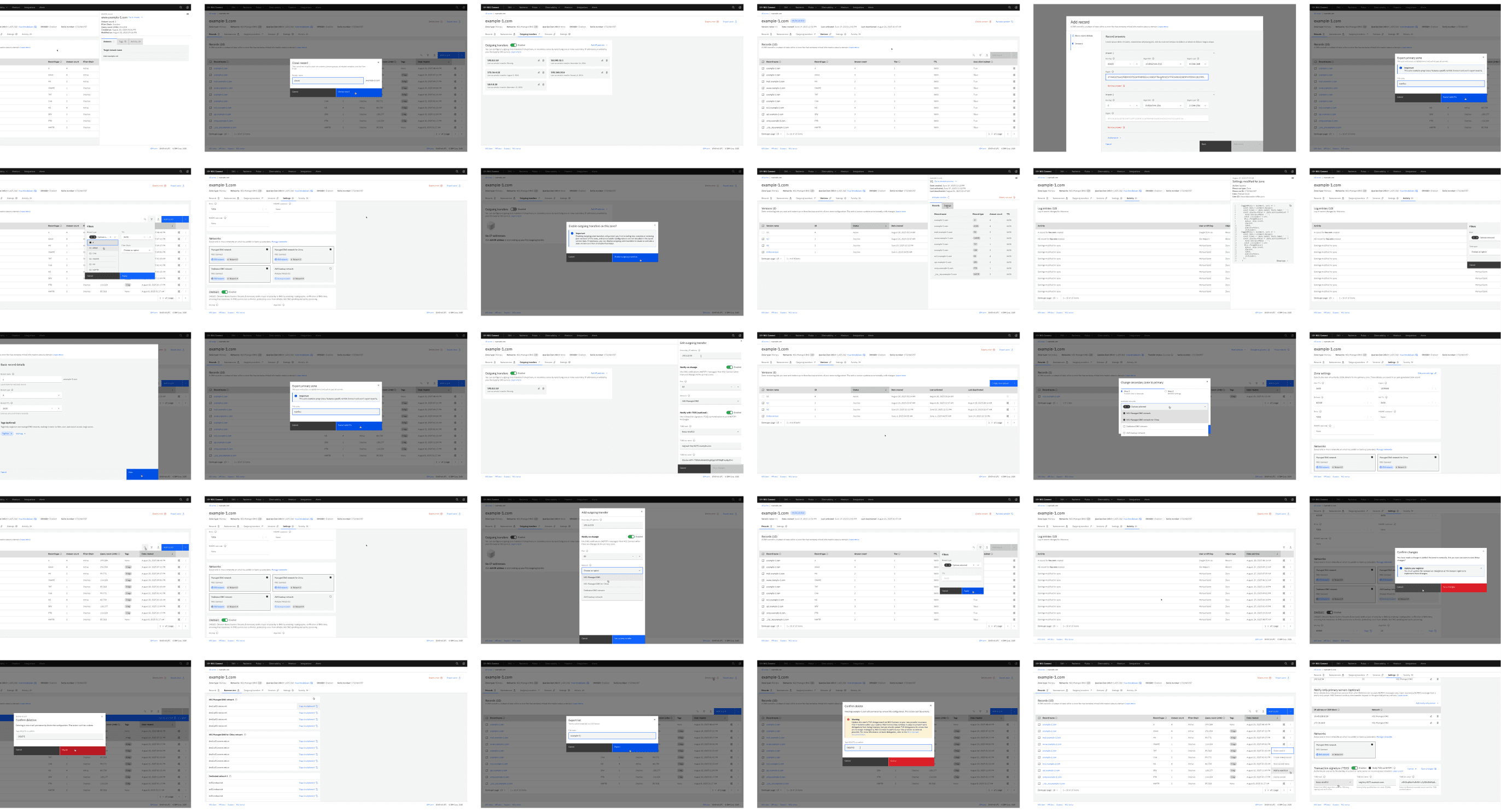
With priorities defined, we broke the third phase into focused stages — each scoped to a specific page starting with the Zones and Records section of the portal.
We redesigned every user flow around established Carbon components and patterns. Every path and state was accounted for, so users could move through the product with confidence and minimal friction.
Engineering partnered closely to evaluate Carbon's component capabilities and ensure each piece functioned correctly and surfaced the right information based on user context. The content team worked alongside us to craft clear, purposeful copy — headers, descriptions, labels, tooltips, helper text — keeping users oriented throughout the experience.
3. Design documentation
In a large organization like IBM, multi-year projects like this move in batches. What gets designed today might not reach a developer for months, which made thorough documentation critical. Any engineer eventually assigned to deliver a portion of the experience needed to understand the intent and expected behavior without chasing down context from the design team.
That meant every breakpoint, state, and UI feedback pattern was documented clearly enough for developers to implement with minimal supervision. The goal wasn't to hand off a file and walk away — it was to reduce the need for constant context-switching so designers could stay focused on other products without becoming a bottleneck for engineering.
The Impact
The redesign was still in progress when I left IBM, but the foundation I built is carrying the project forward. The phased approach and thorough documentation meant the work didn't depend on my presence to continue — the team had a clear roadmap, defined patterns, and detailed specs to execute against. The project is actively moving toward completion, bringing NS1 closer to full WCAG 2.1 AA compliance and the federal market opportunity that comes with it.
What I learned
Alignment is everything
Redesigning a mission-critical product like NS1 Connect takes considerable planning and alignment. It wasn't as simple as swapping in Carbon components and calling it done. I needed to account for stakeholder needs across PM, dev, and information design — maintaining continuous pulse checks to ensure everyone could give input and be part of the process.
Design systems are not silver bullets
The core promise of any robust design system is to accelerate the speed and quality of design and delivery through a comprehensive set of components and guidelines. Carbon delivers on this promise, but only up to a point.
We went into the project knowing we'd rely heavily on Carbon to solve the issues our users were experiencing. But we quickly realized that every design system has limits. There will be instances where you need to break away from the system to account for user needs. After all, that's how systems grow.
User confidence is a priority
Most enterprise software interfaces are made up of seemingly basic components—tables, forms, checkboxes, charts. But what's often overlooked is how these components come together to create an experience that instills confidence.
Tools like NS1 Connect give users the power to make or break the backbone of their application and service availability. The question designers working on similar tools should keep top of mind is: How confidently will users rely on these tools? Climbers, electricians, and firefighters always say, "Trust your gear." It's our responsibility to design tools worthy of that trust.